
Some travel problems are easy to predict.
Long immigration lines.
Heavy luggage.
A train platform that looks confusing at first.
But the one that catches many travelers off guard in Korea is much smaller.
Your phone has no data.
It does not feel like a big problem until you try to check the route to your hotel, translate a sign, message your host, or open a taxi app after a long flight.
Korea is a very connected country, and that is exactly why being disconnected feels so inconvenient.
So before choosing the cheapest option, it is worth asking a better question:
Which one actually fits your trip — eSIM, SIM Card, or Pocket WiFi?
This guide keeps it simple.
No endless plan comparison.
No confusing tech talk.
Just the real differences travelers should know before arriving in Korea.
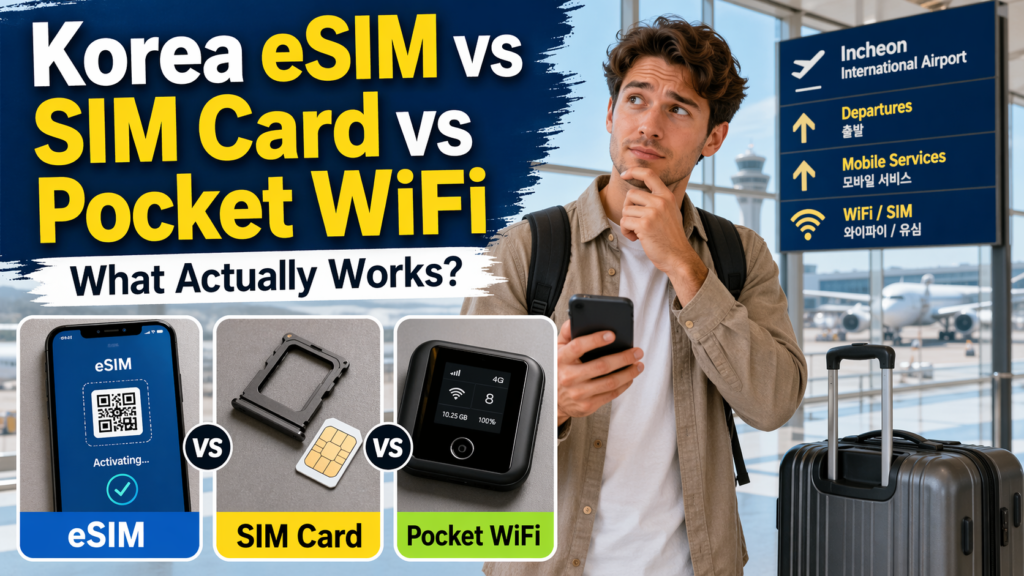
Quick Answer: Which One Should You Choose?
For most short-term travelers, eSIM is the easiest choice.
It is simple, fast, and does not require you to remove your original SIM card. You can usually install it before your flight and activate it after arriving in Korea.
But eSIM is not always the best option for everyone.
Choose eSIM if you want the easiest setup
Choose eSIM if:
- Your phone supports eSIM
- Your phone is unlocked
- You are traveling alone or as a couple
- You mainly need data for maps, translation, messaging, and transport apps
- You want to avoid airport counter lines
Choose a SIM Card if you want a physical option
Choose a SIM Card if:
- Your phone does not support eSIM
- You prefer using a physical SIM
- You want a plan that may include a Korean phone number, voice, or SMS
- You do not mind swapping SIM cards
Choose Pocket WiFi if you are traveling as a group
Choose Pocket WiFi if:
- You are traveling as a family or group
- Several people need internet at the same time
- You want to connect phones, tablets, or laptops
- You do not mind carrying and charging one extra device
The simple version is this:
eSIM is best for convenience.
SIM Card is best for physical SIM users.
Pocket WiFi is best for groups.
Why Mobile Internet Matters So Much in Korea
Korea has excellent public transportation, fast mobile networks, and a very digital travel environment.
That sounds convenient, and it is.
But it also means that mobile internet becomes part of almost every travel moment.
You may need data for:
- Naver Map (네이버지도)
- KakaoMap (카카오맵)
- Papago (파파고)
- Kakao T (카카오 T)
- Subway and bus routes
- Restaurant searches
- Hotel messages
- Booking apps
- Emergency contact with your group
Free WiFi is available in many places, including airports, cafes, hotels, and some public areas. But relying only on free WiFi is not a good idea.
The moment you step outside, get lost, or need to check a route quickly, mobile data becomes essential.
That is why your internet option should be decided before you arrive.
eSIM in Korea: The Easiest Choice for Most Travelers
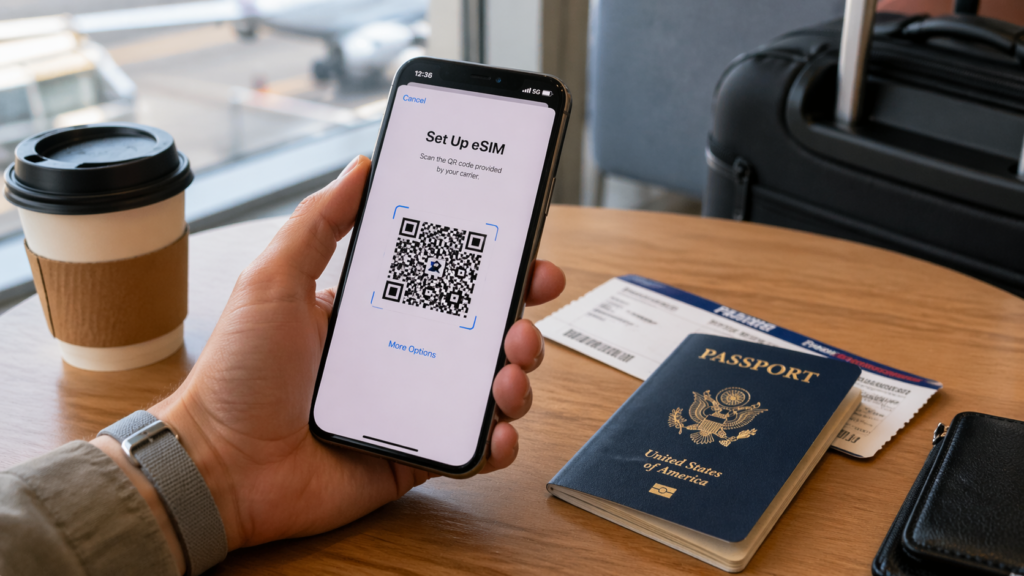
An eSIM is a digital SIM installed on your phone. Instead of inserting a physical card, you usually scan a QR code or install the plan through an app.
For many tourists, this is the easiest option.
You can buy it before your trip, set it up before boarding, and turn it on when you arrive in Korea.
There is no airport counter line.
No physical card.
No extra device to carry.
This is especially useful if you arrive late at night or want to go straight from Incheon International Airport (인천국제공항) to your hotel.
The biggest advantage of eSIM is convenience.
You can keep your original SIM card in your phone and use the Korean eSIM for data. This can be helpful if you still need to receive messages from your home country.
But before buying an eSIM, check two things.
Your phone must support eSIM.
Your phone must be unlocked.
If your phone is locked to a carrier in your home country, a Korean travel eSIM may not work. If your phone does not support eSIM, you need a physical SIM Card or Pocket WiFi instead.
Also, many tourist eSIM plans are data-only. That means you can use the internet, but you may not get a Korean phone number.
For most short-term travelers, that is fine.
You can still use maps, translation apps, messaging apps, social media, booking apps, and transport apps.
But if you need local calls or SMS, always check the plan details before buying.
SIM Card in Korea: Still Useful for Some Travelers
A physical SIM Card is the traditional option. You insert it into your phone and use a Korean mobile network during your trip.
SIM Cards still make sense in Korea, especially if your phone does not support eSIM.
You can often reserve one online and pick it up at the airport, or buy one after arrival depending on availability and counter hours.
Some tourist SIM Card plans are data-only. Others may include voice, SMS, or a Korean phone number.
This is where travelers need to be careful.
Not every SIM Card gives you the same features.
A cheap data-only SIM may be enough for maps and translation, but it may not help if you need local calls or text messages.
Also, having a Korean phone number does not always mean you can complete every Korean identity verification process.
This is an important point.
Some Korean websites and apps require local identity verification connected to a registered phone number or stricter local systems. A tourist SIM may help in some situations, but it does not automatically unlock every Korean service.
So do not buy a SIM Card only because you think, “I need a Korean number for everything.”
Most tourists do not.
For basic travel, mobile data is usually enough.
A SIM Card makes sense if your phone does not support eSIM, you prefer a physical card, or you specifically want a plan with voice or SMS.
The downside is simple.
You may need to remove your original SIM card, keep it somewhere safe, and avoid losing it during your trip.
For some travelers, that is no problem. For others, eSIM is much easier.
Pocket WiFi in Korea: Best for Families and Groups
Pocket WiFi is a small portable WiFi router. You rent the device, carry it with you, and connect your phone to it like regular WiFi.
It can be very useful in Korea, especially for families or groups.
If three or four people are traveling together, one Pocket WiFi device may be more practical than buying separate eSIMs or SIM Cards for everyone.
It can also connect multiple devices, such as phones, tablets, and laptops.
That sounds great, and sometimes it is.
But Pocket WiFi has one clear downside.
You have to manage it.
You need to pick it up.
You need to return it.
You need to charge it.
You need to carry it every day.
And if the battery dies, everyone connected to it loses internet.
Pocket WiFi can also be inconvenient when your group splits up. The person holding the device is the person holding the internet.
That is why Pocket WiFi is usually not the best choice for solo travelers.
If you are alone, carrying another device just for internet may feel unnecessary. An eSIM is usually simpler.
But if you are traveling with family, children, or friends who all need internet, Pocket WiFi can still make a lot of sense.
Just bring a power bank and check the return location before your final day in Korea.
Comparison Table: eSIM vs SIM Card vs Pocket WiFi
eSIM
Best for: Solo travelers, couples, short-term visitors, people who want the easiest setup
Main advantage: Fast and convenient. No physical card needed.
Main downside: Your phone must support eSIM and be unlocked. Some plans are data-only.
Good for: Maps, translation, messaging, social media, taxi apps, and booking apps
SIM Card
Best for: Travelers who want a physical option or whose phones do not support eSIM
Main advantage: Familiar and widely available. Some plans may include voice, SMS, or a Korean phone number.
Main downside: You may need to swap SIM cards and keep your original SIM safe.
Good for: Data, possible local calls, longer stays, and travelers who prefer airport pickup
Pocket WiFi
Best for: Families, groups, and travelers with multiple devices
Main advantage: Several people can connect at the same time.
Main downside: You need to pick it up, return it, charge it, and carry it.
Good for: Group travel, laptops, tablets, families, and shared internet use
Do You Need a Korean Phone Number in Korea?
Most tourists do not need a Korean phone number for a normal Korea trip.
If you mainly use Naver Map (네이버지도), KakaoMap (카카오맵), Papago (파파고), WhatsApp, Instagram, hotel apps, and transport apps, data is usually enough.
However, a Korean phone number can be helpful in some cases.
It may help with:
- Local calls
- Some restaurant waiting systems
- Certain reservations
- Receiving local SMS from specific services
- Longer stays
But there is one thing you should not misunderstand.
A Korean phone number does not always mean you can complete Korean identity verification.
Some services require verification connected to Korean resident registration, local carrier registration, or stricter identity checks. A tourist SIM or travel eSIM may not be enough for every app or website.
So before paying extra for a Korean number, ask yourself:
Do I really need calls and SMS?
Or do I just need mobile data?
For most travelers, data is the main thing.
Common Mistakes Tourists Make
Buying an eSIM without checking phone compatibility
Not every phone supports eSIM. Even if it does, your phone must also be unlocked.
Check this before buying.
Assuming “unlimited data” always means full-speed data
Some plans may reduce speed after a certain amount of high-speed data.
Always read the details before purchasing.
Waiting until arrival to decide
Airport WiFi can help, but it is stressful to compare plans after a long flight.
It is better to choose your internet option before landing.
Choosing Pocket WiFi for a solo trip
Pocket WiFi works, but carrying and charging another device can become annoying if you are traveling alone.
Thinking a Korean number solves everything
A Korean phone number can be useful, but it does not guarantee access to every Korean verification system.
My Simple Recommendation
If you are visiting Korea for a short trip and your phone supports eSIM, choose eSIM.
It is the easiest option for most travelers.
If your phone does not support eSIM, choose a SIM Card.
It is reliable, familiar, and easy to understand.
If you are traveling with family or a group, consider Pocket WiFi.
It can be practical when several people need internet at the same time, as long as you do not mind carrying one extra device.
Here is the easiest way to decide:
Solo traveler?
Choose eSIM.
Couple?
Choose eSIM, or two separate eSIMs.
Family or group?
Consider Pocket WiFi.
Need local calls or SMS?
Check a SIM Card or eSIM plan with a Korean number.
Only need maps, translation, and messaging?
Data-only eSIM is usually enough.
Final Thoughts
Mobile internet is not just a small travel detail in Korea.
It affects how you move, translate, search, book, and explore.
The good news is that Korea becomes much easier once your phone is connected.
You do not need the most expensive plan.
You do not need every feature.
You just need the option that fits your trip.
For most travelers, that means eSIM.
For some, a SIM Card still makes sense.
For families and groups, Pocket WiFi can still be useful.
Choose before you fly, check the details carefully, and your first hour in Korea will feel much smoother.
Korea Easy Guide — Travel Korea, made simple. Your first friend in Korea.
-

Things to Do in Seoul at Night: Safe Walking Spots After Dinner
Looking for things to do in Seoul at night? Here…
v
—
-
Korea eSIM vs SIM Card vs Pocket WiFi: What Actually Works for Travelers
Some travel problems are easy to predict. Long immigration lines.Heavy…
v
—
-

DMZ Tour from Seoul: What to Expect, What to Bring, and Mistakes to Avoid
DMZ Tour from Seoul: What to Expect, What to Bring,…
v
—
-

South Korea in May 2026: Weather, Holidays, and Crowds
South Korea in May looks easy from a distance. The…
v
—