
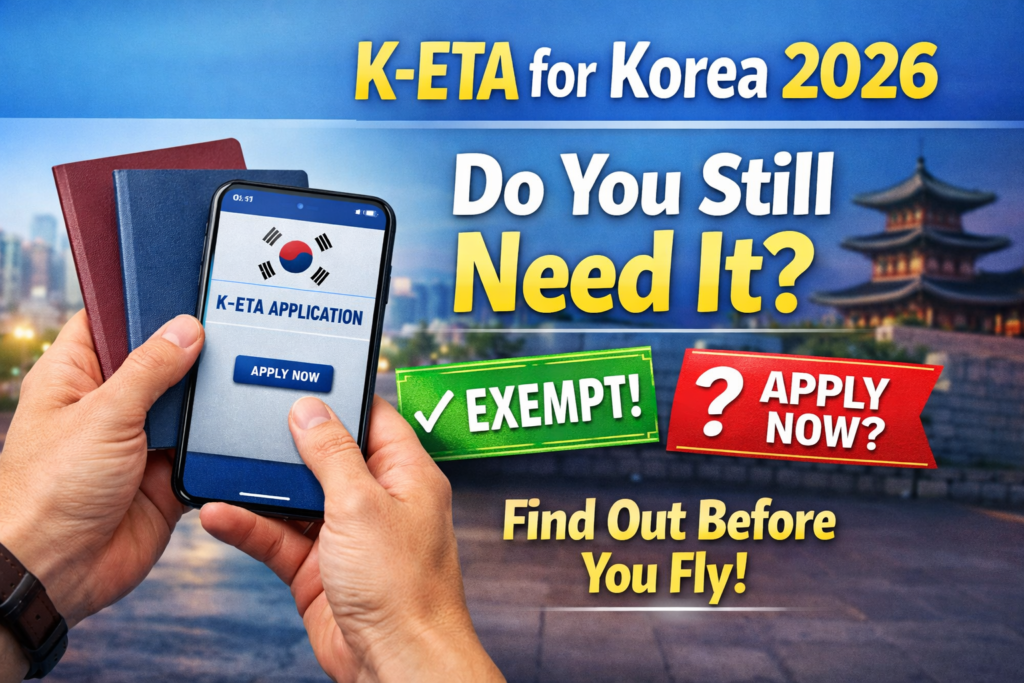
A lot of travelers are still asking the same question in 2026:
“Do I need K-ETA for Korea, or not?”
The confusing part is that both answers you see online can sound correct.
A few years ago, many travelers from visa-free countries had to apply for K-ETA before boarding a flight to Korea. Then Korea introduced a temporary exemption for selected countries and regions. That exemption was first announced for the period from April 1, 2023 to December 31, 2024, then extended through December 31, 2025, and has now been extended again through December 31, 2026.
That is exactly why so many travelers get mixed up.
An older blog post may tell you K-ETA is mandatory. A recent short-form video may say you do not need it anymore. A friend who visited Korea last year may tell you something completely different from what applies to your passport in 2026.
And that is the real issue:
K-ETA in 2026 is not a simple yes-or-no rule for everyone. It depends on your nationality, your passport status, and whether you are covered by Korea’s temporary exemption.
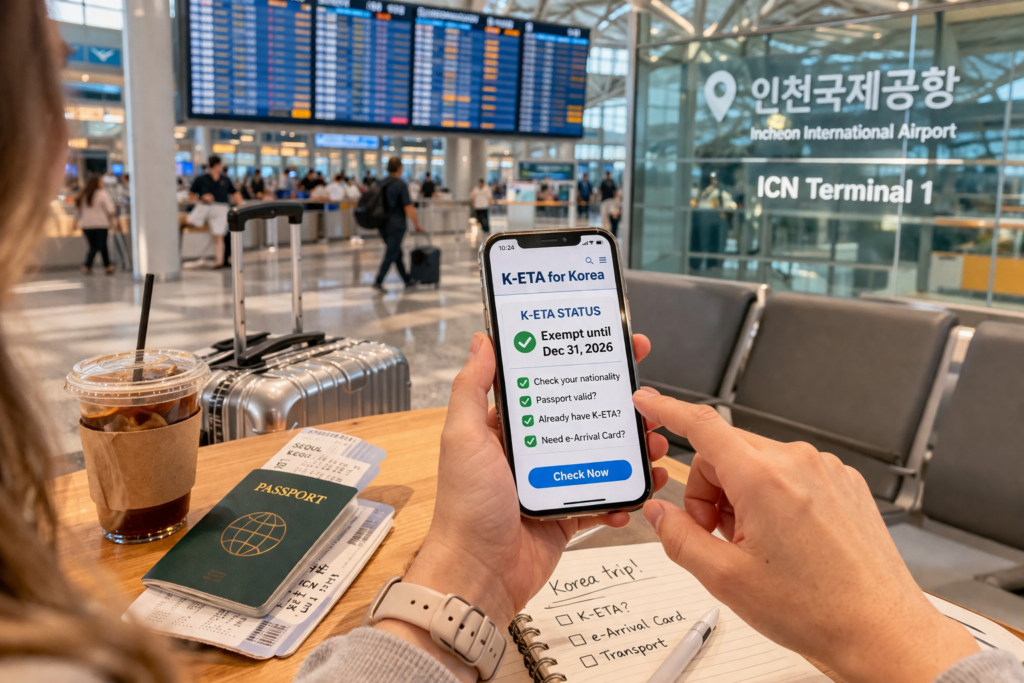
[IMAGE HERE – traveler checking passport and entry requirements on phone]
Upload Image: Tourist reviewing Korea entry rules before departure
What Is K-ETA for Korea(전자여행허가제)?
K-ETA stands for Korea Electronic Travel Authorization. It is an online pre-travel authorization for some travelers entering Korea without a visa. It is not a visa, and even if you have an approved K-ETA, the final entry decision is still made by the immigration officer when you arrive.
That distinction matters more than people think.
Many first-time visitors read “travel authorization” and assume it works like a guaranteed entry permit. It does not. K-ETA is one part of the entry process, not the whole decision.
What Changed for K-ETA in 2026?
This is the part most travelers actually need.
Korea first introduced a temporary K-ETA exemption for selected countries and regions starting on April 1, 2023, originally scheduled to end on December 31, 2024. That exemption was later extended to December 31, 2025, and then extended again to December 31, 2026.
So compared with the earlier rule, the big 2026 change is not that K-ETA disappeared.
The real change is this:
Many travelers from visa-free countries who would normally need K-ETA can currently enter Korea without applying for it, as long as their nationality is included in the temporary exemption list.
That means the most common mistake in 2026 is reading an old guide and assuming the same rule still applies now.
Do You Need K-ETA for Korea in 2026?
The most honest answer is:
Maybe. Check your passport first.
If your nationality is included in Korea’s temporary K-ETA exemption list, you may enter Korea in 2026 without applying for K-ETA in advance. If your nationality is not covered by that exemption but is still a K-ETA-eligible visa-free nationality, then you may still need to apply before boarding.
This is why travelers should stop asking only,
“Do tourists need K-ETA in 2026?”
The better question is,
“Does my passport nationality still require K-ETA in 2026?”
Two travelers can depart from the same airport on the same day and face different rules simply because they hold different passports.
The Question Foreign Travelers Really Ask: “Should I Still Apply Anyway?”
Yes, some travelers still choose to apply even when they are temporarily exempt.
Why?
Because approved K-ETA holders are exempt from submitting the arrival card, and some travelers prefer to keep their arrival process simple. Korea’s official sources explicitly say that even travelers who are exempt may still apply voluntarily if they want K-ETA-related convenience benefits. The normal fee still applies, and previously paid fees are not refunded.
For a nervous first-time visitor, that can feel worthwhile.
For others, it may be unnecessary spending.
That is where practical travel advice matters more than generic advice. If you are already exempt and do not mind completing the arrival process another way, you may not need to pay for K-ETA at all.
K-ETA and the Arrival Card Are Not the Same Thing
This is one of the easiest mistakes to make in 2026.
A traveler hears, “You don’t need K-ETA,” and assumes that means there is no entry form to think about at all. That is not always true.
Korea introduced the e-Arrival Card system starting in February 2025, allowing eligible travelers to submit entry information online in advance. Official guidance says most foreign nationals entering Korea are still required to submit an arrival card unless they fall into an exempt category. One of those exempt categories is holding a valid K-ETA.
So in simple terms:
- K-ETA = travel authorization for certain eligible travelers
- e-Arrival Card = digital entry declaration system
- They are related to arrival procedures, but they are not the same thing
This matters because some travelers skip K-ETA due to exemption, then get confused later about whether they still need to complete entry information separately.
What Happens If You Already Had K-ETA Before?
This is another thing many travelers forget to check.
If you previously obtained K-ETA, it may still be valid. The official guidance says K-ETA is generally valid for three years, or until your passport expires if that happens first. Applications submitted before July 3, 2023 followed the earlier two-year validity rule.
But there is an important catch.
If your passport information changed, or if key personal information changed, you may need to apply again even if the old approval period has not expired. Official guidance specifically notes that travelers must reapply if previously submitted information changed, including passport details.
That means one very real traveler mistake is this:
“I already got K-ETA once, so I’m covered.”
Not necessarily.
A renewed passport can change everything.
How Much Does K-ETA Cost?
The official K-ETA site lists the application fee as 10,000 KRW, or roughly USD 7–8. The site also says assessment generally takes within 72 hours, although delays can happen depending on volume and individual circumstances.
That leads to another practical point for foreign visitors:
If you are exempt, paying for K-ETA may simply be unnecessary.
If you are not exempt, do not leave it too late.
A surprising number of travel problems happen not because the rule is complicated, but because the traveler checks too late.
Common Mistakes Foreign Tourists Make with K-ETA in 2026
Here are the mistakes worth calling out clearly.
1) Reading an old article and assuming nothing changed
Many posts written before the 2025 and 2026 extensions are no longer enough on their own. The exemption timeline changed more than once.
2) Assuming “visa-free” automatically means “nothing to prepare”
Visa-free entry and K-ETA exemption are not always the same practical experience. You may still need to think about arrival declaration rules or other entry procedures.
3) Using a non-official agency website
Korea’s official K-ETA site states that applications are available only through the official website or the official mobile app. Travelers using other sites may pay extra service fees for something they could have done directly.
4) Forgetting that a new passport can affect your old approval
An old K-ETA does not automatically stay usable if your passport details changed.
5) Thinking K-ETA guarantees entry
It does not. Final admission is decided by immigration at the port of entry.
6) Waiting until the airport
Official guidance says travelers who need K-ETA should obtain approval before boarding. In practice, “I’ll sort it out at the airport” is one of the worst approaches you can take.
The Best Way to Check Your Situation Before Flying
The safest approach is not to guess from social media.
Before your trip, check:
- your passport nationality
- whether that nationality is still temporarily exempt in 2026
- whether you already hold a valid K-ETA
- whether your passport has changed since your last approval
- whether you need to complete an arrival declaration separately
This takes only a few minutes, but it can save you from airport confusion, extra fees, or last-minute stress before boarding.
So, Do You Need K-ETA for Korea in 2026?
Here is the clean answer.
Some travelers still need K-ETA. Many others are temporarily exempt through December 31, 2026.
If your nationality is on the exemption list, you may not need to apply.
If it is not, you may still need K-ETA before boarding.
If you are exempt but want the convenience of entering with an approved K-ETA, you can still apply and pay the standard fee.
The biggest takeaway for foreign travelers is simple:
Do not ask whether K-ETA exists in 2026. Ask whether your passport still needs it.
That one question will save you much more time than reading ten conflicting travel posts.
Final Thoughts
Korea trip planning often feels easy until the small details show up.
A train card.
A local map app.
An airport transfer.
An entry form.
A travel authorization you may or may not need.
K-ETA is exactly that kind of detail.
It looks small, but it can become the reason your trip starts with confusion instead of excitement. So before you fly to South Korea(한국), check your passport status first, use only the official channels, and make sure you are not relying on last year’s rules for this year’s trip.
Travel Korea, made simple. Your frist friend in Korea.